.webp)
.webp)


Social SEO: How TikTok & Instagram Will Become Search Engines in 2026
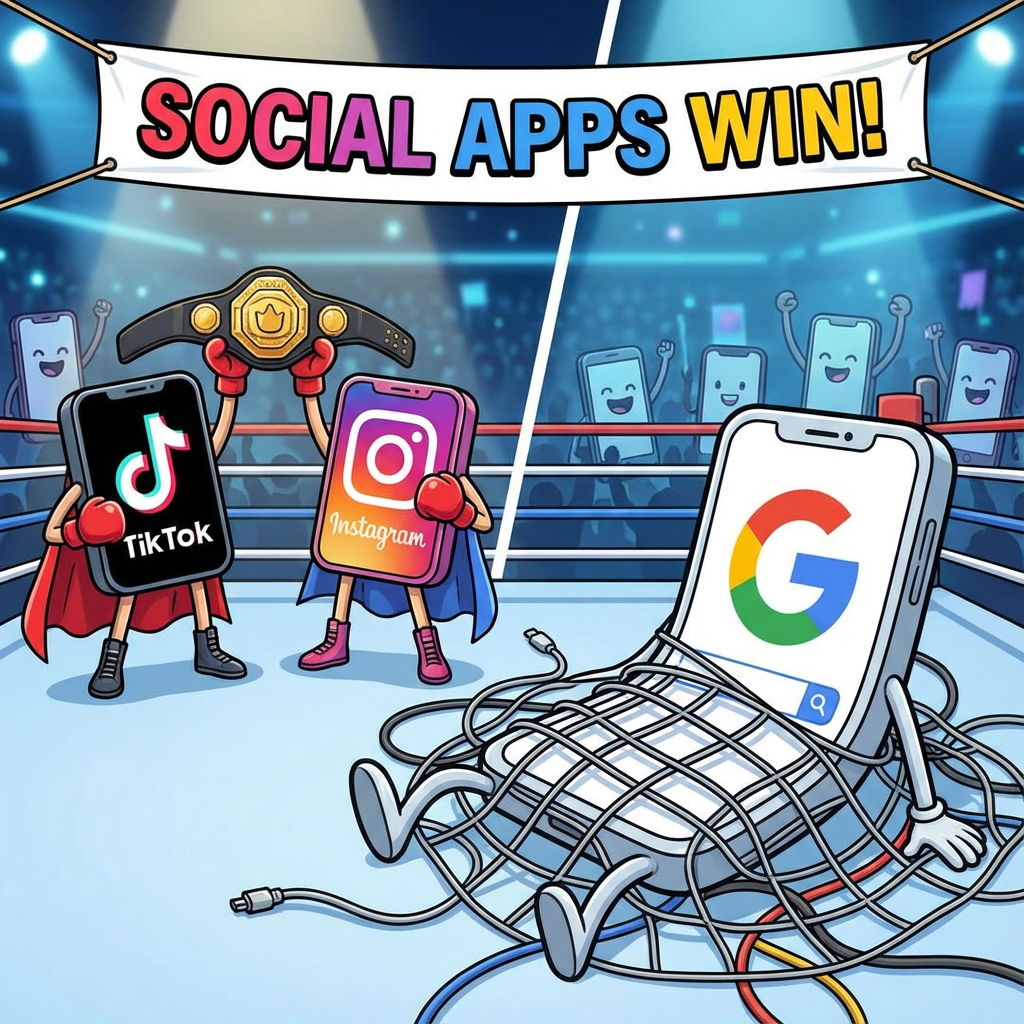
For several years, Google has been the very definition of search. By 2026, that is no longer the whole truth. For more and more users, information retrieval does not start in a search engine, but in social media. TikTok and Instagram have evolved from pure entertainment platforms to active search and discovery channels — especially among younger audiences, but also in professional contexts.
This shift is changing how businesses have to think visibility. It's no longer just about ranking in Google, but about being found where people are actually looking.
TikTok and Instagram do not work as traditional search engines, but as Intention-based Discovery Engines. Users aren't necessarily looking for long, specific questions — they're looking for inspiration, explanations, recommendations, and experiences.
Examples of typical searches:
These are searches that used to belong to Google, but which now often provide better, faster and more relevant answers in video and visual format.
Although TikTok and Instagram are primarily perceived as social platforms, in practice the algorithms work on many of the same principles as traditional search engines. Content is assessed based on how relevant it is to the user's intention, based on the consistency between theme, text, sound and what the user is actually searching for or engaging in. At the same time, engagement plays a crucial role. Watch time, saves, comments and shares give clear signals about how useful or interesting the content is perceived, and affect how widely it is distributed.
The context around the content is also important. Text in the video itself, captions, hashtags and visual elements are actively used by the algorithms to understand what the post is about and who it is relevant to. Over time, consistency is also considered, in which accounts that publish repeated posts within the same topic are more easily associated with a particular area of interest. The difference from classic search is that everything happens faster, more dynamically and with a greater emphasis on actual user interaction. A post that provides real value can therefore achieve significant reach, even without an established following.
Social search is rarely about “what is”. It is about:
Where Google often gives theoretical answers, TikTok and Instagram provide practical demonstrationsexperience, and context. This is especially important for:
For companies, this means that visibility is achieved not through one viral video, but through clear thematic positioning over time.
Social SEO success is all about structure and intention — not random trends.
Use the search fields in TikTok and Instagram actively. The suggestions that appear are real searches from users. Create content that responds specifically to these.
The first few seconds determine both viewing time and algorithmic comprehension. Say explicitly what the video is about, both visually and verbally.
Captions, subtitles and text in video act as metadata. Use natural language, not hashtags without context.
The algorithms reward accounts that cover a topic thoroughly over time. Scattered content provides scattered visibility.
The goal is not necessarily the most views today, but to be found in three weeks -- or three months -- when someone searches for the solution you offer.
Social SEO won't replace Google — but it expands the visibility surface. Content that performs well in social channels builds brand awareness, trust and authority.
This also affects click-through rates, branded search and cross-channel conversion. In practice, visibility becomes a result of holistic presence, not individual ratings.
In 2026, searches are fragmented. Users expect quick, visual and human responses -- where they already are. Companies that continue to think of SEO only as Google optimization run the risk of becoming invisible to large parts of the market.
Those who succeed are those who understand that TikTok and Instagram are not only channels for distribution, but active search enginesfor discovery, assessment and decision.
Do you want to understand how your content can be found both in Google and in social platforms? We help businesses develop content strategies that build visibility where the customer journey actually starts.
.webp)