Market analysis: How companies make better decisions

A market analysis provides your business with insight into customers, competition, demand, and risk. Learn seven steps, useful tools, and how to turn findings into action.
Are you planning to launch a new product, reach a new customer segment, or enter a new market? Before you invest, you should examine how many customers you can realistically reach, what might make them choose you over your competitors, and whether your revenue will cover your costs.
We show you how to research the market, assess the reliability of your data, and compile your findings into a simple market analysis. We also look at what happens after the analysis, when insights need to be turned into strategy and action.
A market analysis is a systematic assessment of customer needs, demand, competitors, and factors affecting the market. The purpose is to provide a better foundation for deciding who to sell to, what to offer, and how realistic your plans are.
The terms are sometimes used interchangeably, but they describe different tasks.
Market research involves gathering information, for example through interviews or surveys. It can be part of a broader market analysis, where findings are evaluated alongside competition, finances, and market trends.
A marketing analysis, on the other hand, looks at the marketing you are already doing: channels, campaigns, costs, and results. If you want to investigate why your advertising isn't delivering the desired effect, we at We Assist offer a dedicated marketing analysis. That is a different task than assessing the potential of a new market.
It is not just large companies that need market insight. Smaller businesses can also face choices that have consequences for staffing, liquidity, and future growth.
A market analysis is particularly useful when you:
• are considering launching a new product or service
• want to reach a different customer segment or change your positioning
• notice that sales or demand are changing without knowing why
• are considering a new geographic market or planning to invest in increased capacity
The scope must be adapted to the risk. A small change in your offering can be tested quickly, while an initiative involving inventory, new hires, and long-term agreements requires more thorough investigation. Prioritize what can actually change the decision.
A market analysis should be based on what the company actually needs to know. The steps below can be carried out in different orders, and some of them overlap. Together, they provide a practical framework for moving from an idea to an informed choice.
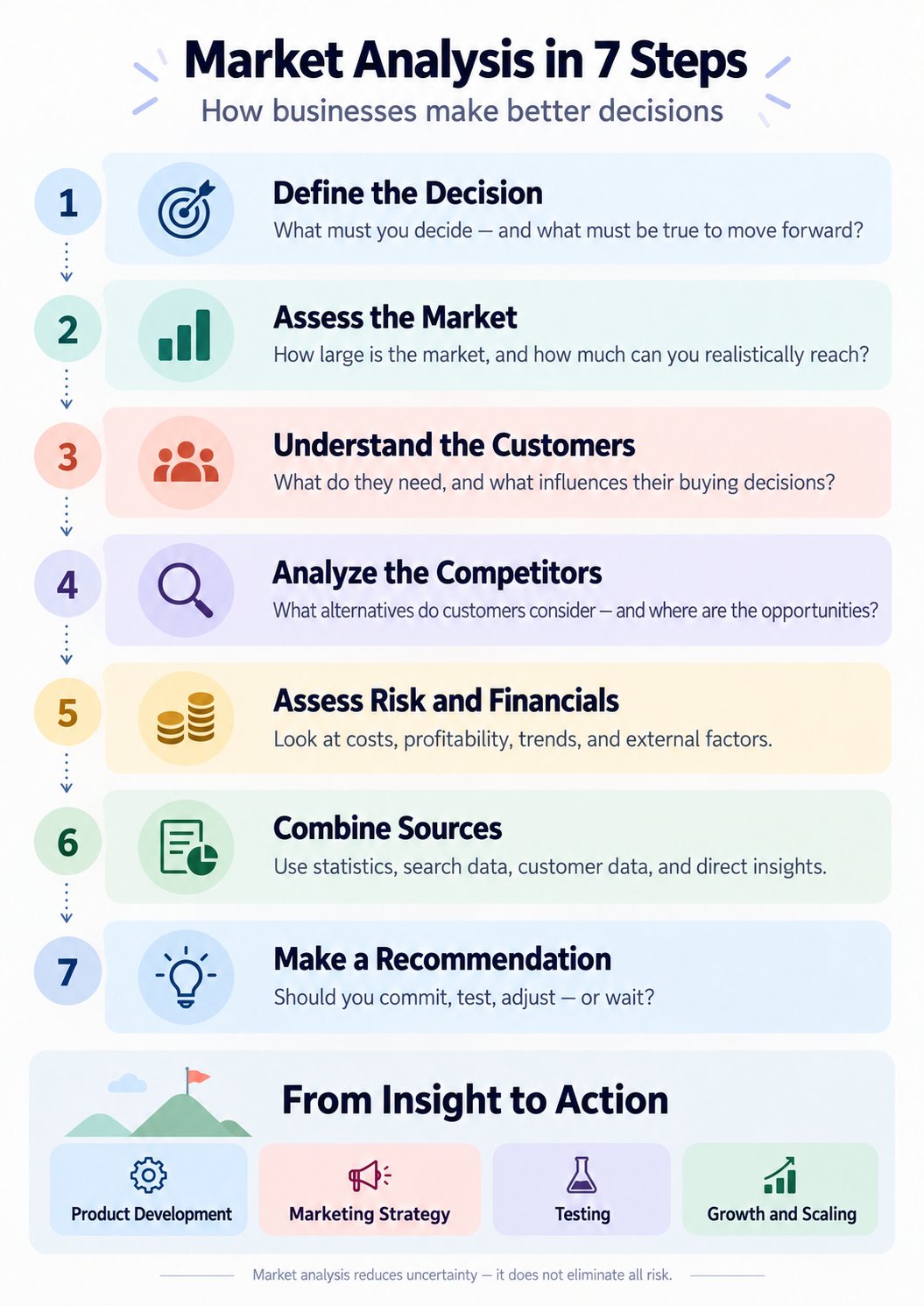
Start with the decision, not the tools. "We want to know more about the market" can quickly become an overly broad task. "Should we offer service agreements to small business customers in Oslo?" on the other hand, provides a clear direction. Then you know which customers, competitors, and costs are relevant.
Also clarify what it will take to move forward. If profitability depends on a price customers are unwilling to pay, the analysis must investigate exactly that. When criteria are formulated in advance, it is harder to overlook uncomfortable findings later.
An estimate of the entire market may seem impressive, but it says little about what your specific company can sell. It is useful to distinguish between the total addressable market (TAM), the portion you can serve (SAM), and the portion you can realistically win (SOM). But start with common questions: How many relevant customers are there, how many can we reach, and do we have the capacity to deliver?
The number of potential customers is not a sales forecast. In the example from Oslo below, we show why the right target group matters more than the total population.
Who experiences the problem? Who evaluates the solution? Who decides if the money should be spent? In B2B, these can be three different people. For an online store, price, delivery time, return policies, and trust can be just as important as the product itself.
Interviews, customer inquiries, lost bids, reviews, and CRM data can show what influences the choice. It is often more enlightening to ask "How did you solve this last time?" than "Would you buy our product?". The former is about actual behavior; the latter can result in a polite "yes" without anyone actually making a purchase.
A few interviews can uncover a problem, but they cannot determine what proportion of the market has it. Use such findings to formulate hypotheses that can be investigated further.
A competitor is not just a business with a similar product. The customer can also choose to continue with their current solution, perform the task internally, or postpone the purchase. Therefore, you should compare the alternatives the customer is actually considering.
Look at price, total cost, delivery, quality, service, contract terms, and communication. Where are the competitors strong? Where do customers have to compromise? A potential gap in the market is only a business opportunity when you can demonstrate that someone is willing to pay to have that need met.
Do not confuse competitors' advertising or estimated website traffic with documented sales figures. Such observations tell you something about visibility, not necessarily about profitability.
Framework conditions can determine whether an idea is feasible. Consumer purchasing power, new technology, seasonal variations, regulations, and changing buying habits can affect the result. PESTEL is a model for categorizing such factors, but you do not need a long list of everything happening in society.
Choose the factors that could change the decision. For a service company, this might be hours spent and recruitment. For an online store, it might be product costs, shipping, and returns. When expanding to another country, you must also consider language, local payment solutions, and administrative requirements.
Calculate both one-time investments and ongoing costs. What happens if sales are delayed, or if the cost of acquiring a customer is higher than expected? A market may be attractive, but too expensive to serve with your current business model.
There is rarely a single source that provides the complete answer. Public statistics can indicate market size, search data can show interest, and customer conversations can reveal motivations. Order data and paid tests can tell you more about what people actually do. None of these sources measure exactly the same thing.
Look at dates, geography, definitions, and sample sizes. If search interest is increasing while your company's sales are falling, you should investigate the possible explanations rather than choosing the number you like best. Perhaps the traffic is coming from the wrong target audience, or perhaps competitors have improved their offerings.
Distinguish between documented findings, indications, and assumptions. Multiple independent sources pointing in the same direction provide a better foundation than a single claim repeated in several places. A SWOT analysis can summarize the results, but it should not replace the investigation itself.
Now it is time to put the information to use. What are the arguments for moving forward? What could hinder profitability? Which questions do you still lack answers to? The recommendation could be to launch, modify the offering, conduct a limited test, or wait.
It is helpful to decide in advance what a test should measure. A click indicates that someone noticed the offer. A relevant inquiry may show a clearer need. A paid purchase provides stronger evidence of willingness to pay, but it is still no guarantee that the business can grow profitably.
A useful conclusion can be formulated as follows: "We choose to... because..., and we will re-evaluate the decision if...". This turns the analysis into a working document rather than something that gets filed away.
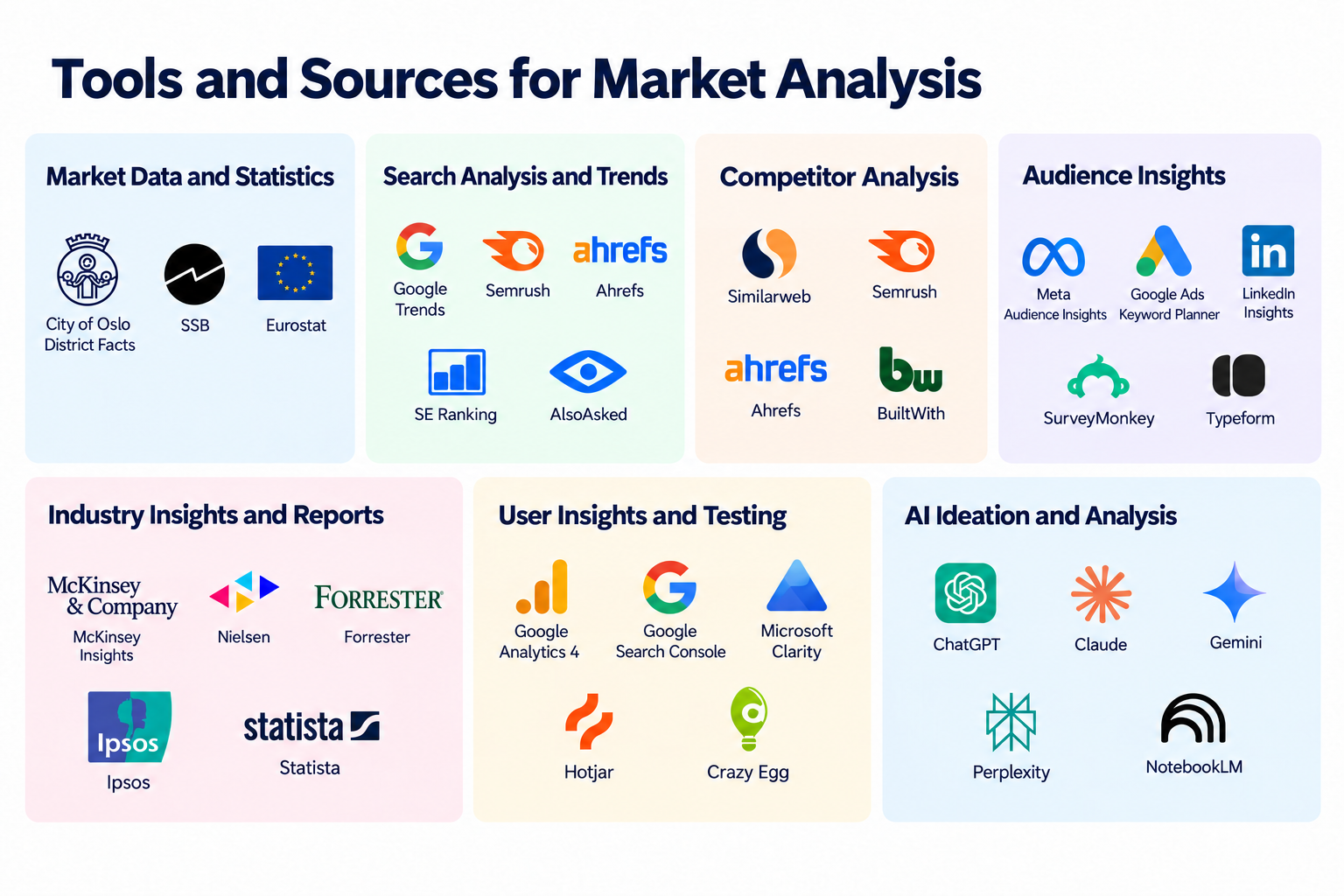
Tools should be chosen based on the question you want to answer, not the other way around. Estimating how many companies exist in an industry, investigating why customers reject an offer, and measuring the effect of an advertising campaign require different types of data.
Some relevant sources include:
• Public figures and industry data: Statistics Norway (SSB), the Brønnøysund Register Centre, and trade or industry associations can provide background on businesses, demographics, and trends. Always check what the statistics are actually measuring.
• Search and traffic data: Google Trends shows relative search interest; Semrush can estimate search volume and organic visibility; Similarweb estimates website traffic. None of them can definitively tell you how much your competitors are selling.
• Internal data: Google Search Console shows which searches generate impressions and clicks for your site. CRM, order data, lost bids, and customer service logs provide insight into behavior and commercial results.
• Direct research and testing: Customer interviews, surveys, and limited pilot projects can shed light on questions that statistics cannot answer. Sample size and test design determine how reliable your conclusions will be.
Imagine a company that wants to start weekly recreational courses for children aged 6 to 12. It is considering two districts in Oslo: Gamle Oslo and Grünerløkka. At first glance, Grünerløkka seems the most interesting. The district has more inhabitants. But is the total population the right starting point when the customers are children in a specific age group?
Figure 1. Population development in Oslo – Gamle Oslo and Grünerløkka (2026). Source: City of Oslo, Bydelsfakta.
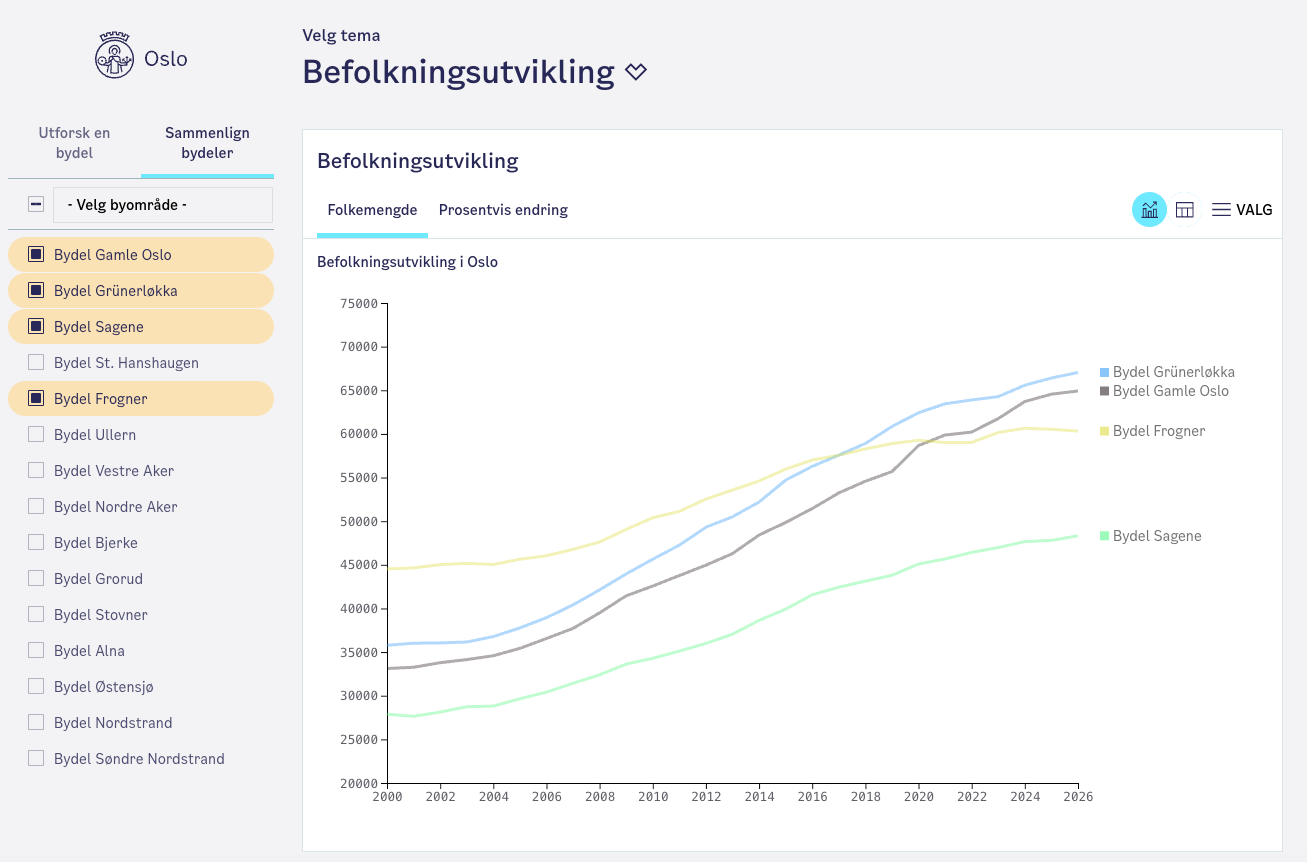
Figures from the City of Oslo's Bydelsfakta for 2026 show the difference. We have used statistics on population development and age distribution.
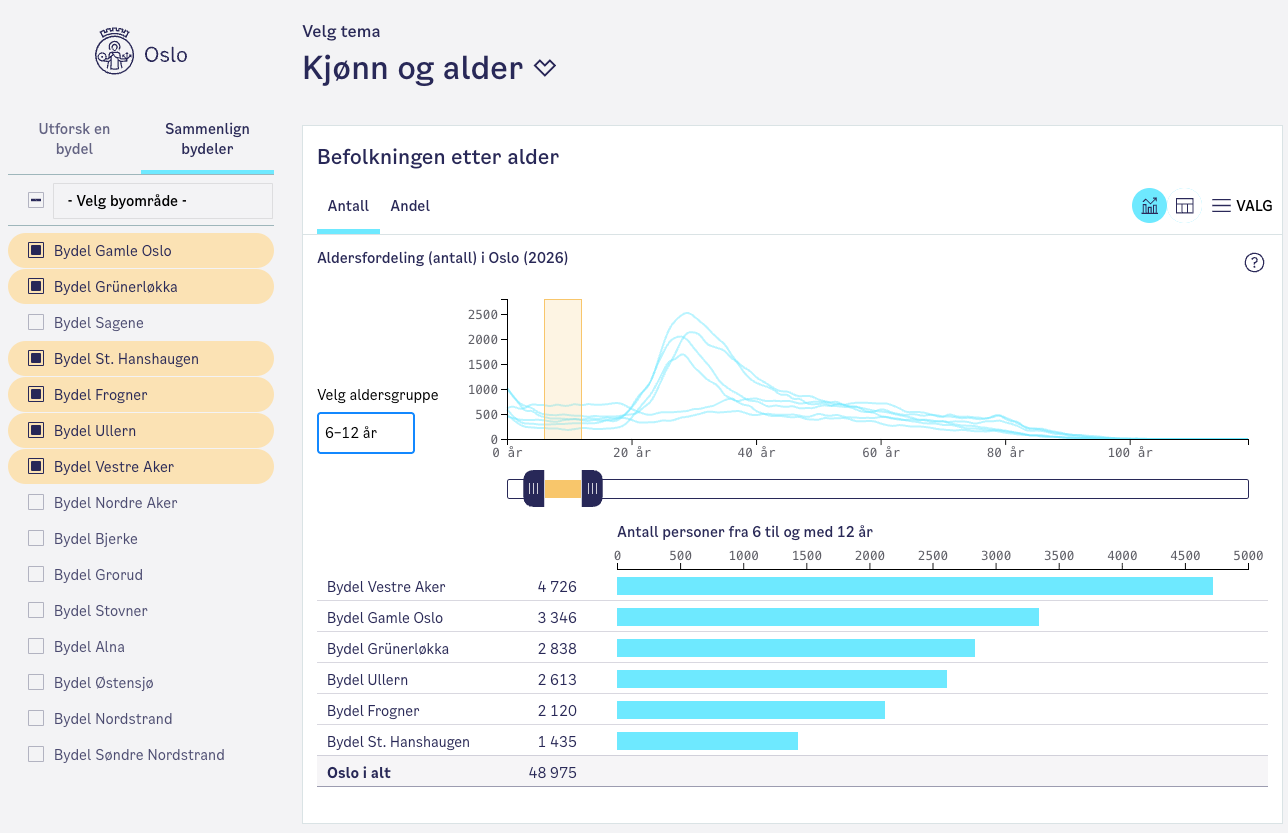
Figure 2. Number of children aged 6–12 in the two districts (2026). Source: City of Oslo, Bydelsfakta.
The figures from the City of Oslo's Bydelsfakta for 2026 show an interesting difference. Grünerløkka has 67,039 inhabitants, while Gamle Oslo has 64,920. But if we only look at children between 6 and 12 years old, the picture is the opposite: Gamle Oslo has 3,346 children in this age group, compared to 2,838 in Grünerløkka.
For a company that wants to start recreational courses for children, Gamle Oslo may therefore be more interesting than the total population initially suggests. However, more children do not necessarily mean more registrations. Parents also consider price, travel distance, and what recreational activities already exist in the area.
Let's test the finances with purely hypothetical amounts. We assume four course evenings a month, space for 12 children, and a monthly price of 1,200 kroner per child. Materials cost 100 kroner per child. Teaching costs 3,600 kroner per month, while marketing and administration cost 2,500 kroner. We assume that renting premises costs 500 kroner per course evening in Gamle Oslo and 750 kroner in Grünerløkka.
This makes the fixed monthly costs 8,100 kroner in Gamle Oslo and 9,100 kroner in Grünerløkka. After material costs, each participant contributes 1,100 kroner to cover fixed costs. Therefore, at least eight children are required in Gamle Oslo or nine in Grünerløkka to cover the calculated monthly costs. With ten participants, there is 2,900 kroner left over in Gamle Oslo and 1,900 kroner in Grünerløkka – before taxes, setup costs, and other expenses not included.
What should the company do? Gamle Oslo might be a sensible place to investigate first, but the decision has not been made. The company must find suitable premises, look at competing courses, consider distance and accessibility, and test whether parents are actually willing to pay – for example, by collecting registrations for a pilot course. Better premises or more clearly documented demand in Grünerløkka could still make that district a better choice.
A good summary makes it easy to see what the analysis shows, how reliable the findings are, and what they mean for the next decision.
A short summary can include:
• Decision and market: What are we considering, for which customers, and in which area?
• Key findings: What do we know about needs, alternatives, demand, and finances?
• Sources and uncertainty: What is confirmed, and what is still based on assumptions?
• Recommendation: Should we go all in, test on a smaller scale, change direction, or wait?
• Next steps: Who does what, what should be measured, and when should the results be evaluated?
What a company does after an analysis depends on the findings. A new product may require further development and testing. Declining demand might mean that the offering needs to be adjusted, while a new target audience may require a different marketing strategy.
The same applies to SEO: A review can uncover problems and opportunities, but improvements only come when the company prioritizes actions, implements them, and follows up on the results. Analysis and execution are two different tasks that must be linked.
At We Assist, we help companies turn insights into a clear marketing strategy and concrete actions. We can assist with prioritizing target audiences, messaging, and channels, executing activities, and following up on results. This ensures better alignment between planning and execution, and reduces the coordination burden for the client. See our digital marketing services.
International growth is one example of why market insight must be followed by execution. If an online store is to establish itself in a new country, it must be adapted to the local market. Payment solutions, marketing, logistics, and customer service must also work together. Through our international scaling service, we can assist with the planning and execution of the tasks we agree upon with the client.
We also have experience in translating market insights into concrete actions for international expansion. In one project, we developed and executed the marketing strategy for a business establishing itself in Denmark. The venture became profitable within the first year.
In another project, we helped a business build up logistics and sales processes for their establishment in Denmark and Germany. The business achieved over 30 orders per day.
Both projects demonstrate how important it is for marketing and practical execution to work together. Read more about our international scaling.
But international growth is just one possible path forward. Whether you are considering a new product, a new customer segment, or a new market, the value of the analysis lies in distinguishing documented opportunities from assumptions – and choosing what to test before you invest further.
If your next step involves target audiences, positioning, and channel selection, you can also read our guide on marketing strategy.