


Marketing Strategy: From Goals to Results in 7 Steps

A good marketing strategy is about more than just choosing the right channels. Learn how to set clear goals, prioritize resources, and create a strategy that delivers results – step by step.
A good marketing strategy is about more than choosing the right channels. Learn how to set clear goals, prioritise your resources and build a strategy that delivers results – step by step.
You post on social media, run ads and update your website. Yet fewer new customers are coming in than you had hoped. What should you do next? Increase your advertising budget, invest more in search engine optimisation (SEO), or focus on the customers you already have?
The best place to start is not by choosing a channel. First, you need to know what your business wants to achieve, who your customers are and why they should choose you. A marketing strategy brings these decisions together and helps you avoid spreading your resources too thin.
In this guide, we walk through seven steps, show you how to put them into practice and share a simple template. Along the way, we draw on projects we have worked on at We Assist.
A marketing strategy explains how your business will use marketing to achieve its business goals. Who do you want to sell to? What value do you offer? Where will you reach potential customers, and how will you assess your results?
A marketing strategy and a marketing plan serve different purposes. The strategy sets out your goals, target audience and reasons for choosing particular activities. The marketing plan covers execution: activities, timelines, budgets and responsibilities. Publishing three LinkedIn posts a week, for example, is an activity. But why LinkedIn? Are your target customers there, and will those posts help you achieve your goal? Your strategy should answer those questions.
Once you know where you are heading, it becomes easier to prioritise activities and say no to those that do not support your goals.
A digital marketing strategy follows the same principles, with a focus on digital channels. If you would like an overview of the available tools first, read our article on what digital marketing is.
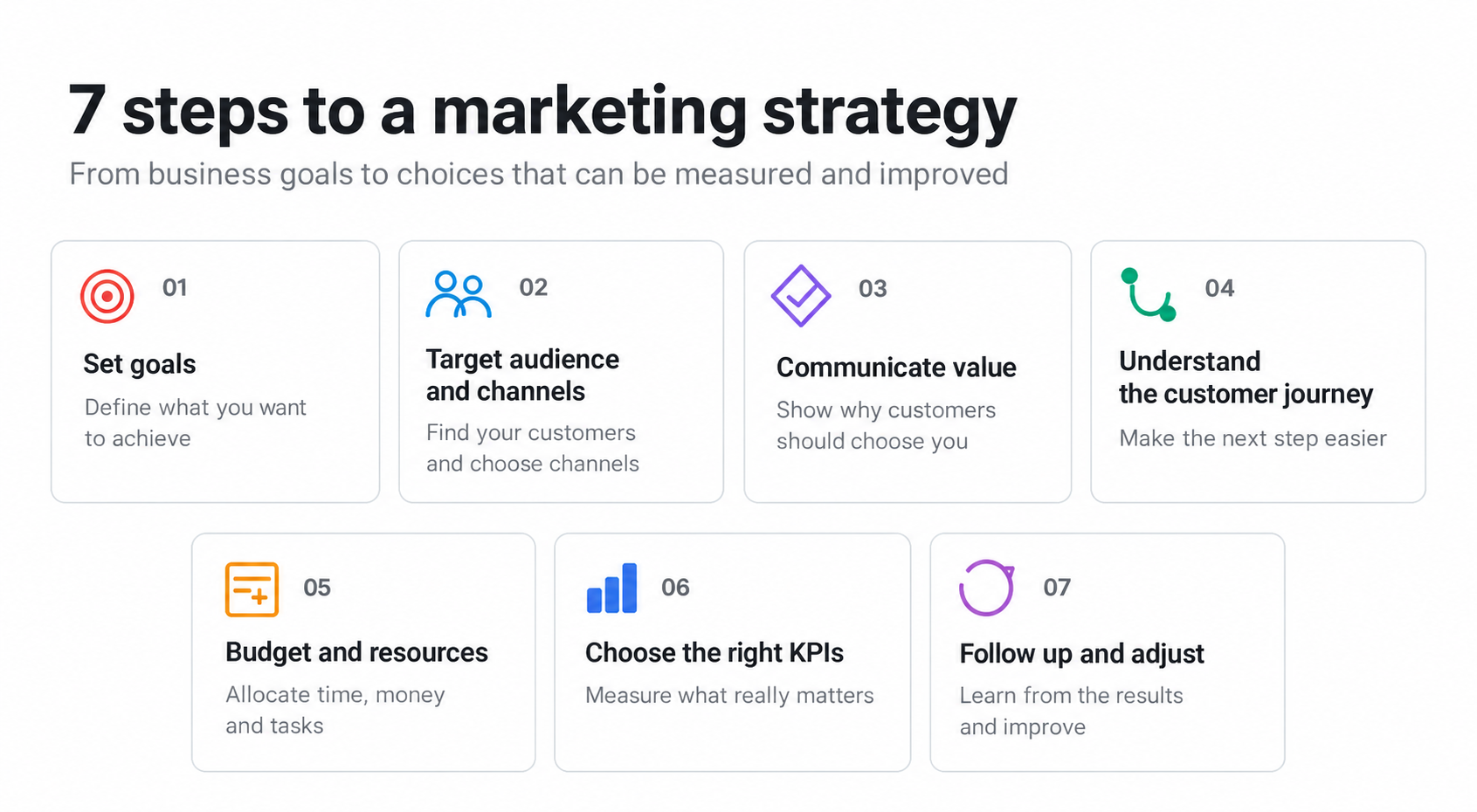
“We want to be more visible” is an understandable ambition. But what should greater visibility lead to? More bookings, more relevant enquiries, or more purchases from existing customers?
Start with a specific business goal. That makes it easier to see which actions are helping and which are simply keeping you busy.
Vague: “We want more customers.”
More specific: “We want to increase qualified enquiries from 8 to 15 per month within six months.”
With a goal like this, you know what to measure and when to review the results.
Before setting your goal, ask:
If you do not have reliable figures for your current performance, establish a baseline first. Without a clear starting point, it is difficult to know how much you have actually grown.
Before spending money on ads, you need to understand who needs what you offer and where those people look for information. Otherwise, you could spend heavily on a popular platform that does little for your business.
Look at who already buys from you, what customers are willing to pay for and what they ask before making a decision. Use insights from your CRM (customer relationship management system), your sales team, website analytics and competitors. The goal is to identify the customers you should prioritise and where you can best reach them.
Which customers are most valuable to our business today, and why?
What alternatives are these customers considering, and what makes our offer different?
Which channels already generate relevant enquiries, and which mainly generate attention without sales?
Consider an IT provider offering support to small businesses without an in-house IT department. It makes more sense to reach people responsible for running those businesses than to advertise to everyone. You still need to research and test which channel works best.
In a digital marketing strategy, your channel choices should reflect how customers actually search for and evaluate solutions:
Imagine a small bakery whose cake photos get lots of likes on Instagram but generate few orders. Before posting more photos, the owner could check how people search for birthday cakes and whether ordering through the website is straightforward. That is a better way to find out what actually drives orders.
For Abralife, attracting more relevant enquiries, particularly from housing cooperatives, was a priority. We used data to identify suitable prospects and ran targeted campaigns on LinkedIn, Meta and Google Ads. We also worked on landing pages and email campaigns.
The aim was to reach a defined audience and help them take the next step towards making an enquiry, rather than simply maximise impressions. Read more in our Abralife client case study.
Other businesses may need completely different channels. Your choices should always be based on who your customers are and how they make purchasing decisions.
“High quality” and “personal service” are claims almost any competitor can make. Your customers want to know what you actually offer and why they can trust you.
This is where positioning and your value proposition come in. Put simply, they explain which problem you solve, who you solve it for and why your offer is relevant compared with the alternatives.
Vague: “We provide high-quality IT services.”
Clearer: “We help small businesses keep their IT running smoothly without needing an in-house IT department.”
The second statement tells customers what they will gain from the service. Of course, your message must also reflect what your business can actually deliver.
Make sure your offer is equally easy to understand on your homepage, in ads, on service pages and during the first conversation with a potential customer. A good strategy should not leave people guessing what you sell.
Imagine you need a plumber. If a pipe bursts, you want a phone number and immediate help. But if you are planning a bathroom renovation, you may spend weeks comparing quotes, reading reviews, asking friends for recommendations and looking into different companies' experience.
That is the customer journey: the path from recognising a need to choosing a provider. For some customers, the journey is quick. Others need more time and information.
One person needs a quick answer. Another wants to see examples of past work, understand the terms or read reviews. It is therefore worth asking:
The better your website and other content answer these questions, the easier it becomes for customers to take the next step. Making it easier for visitors to send an enquiry or complete a purchase is part of conversion rate optimisation (CRO). Your content should also help people who are still comparing their options.
Your strategy must be practical to implement. There is little point increasing your advertising budget if people land on a confusing page or cannot complete an order.
Your budget includes more than ad spend. Factor in content creation, technical work, website improvements, tools and staff time. Sometimes it makes more sense to fix a problem on your website before paying for additional traffic.
When putting your plan together, clarify the following:
There is no single budget or allocation that works for every business. Paid advertising, SEO and brand building come with different costs and time horizons. Choose what fits your goals and resources.
Useful KPIs depend on what you want to achieve. If the purpose of an event is to generate interest, tracking how many people click “Going” on Facebook can be useful. But if your goal is to fill the venue, you also need to know how many people actually turn up.
Likewise, an online store should track purchases, while a B2B business may need to focus on qualified enquiries and cost per lead (CPL). KPIs, or key performance indicators, should tell you whether you are getting closer to your goal – not just provide impressive-looking numbers for a report.
Test that important actions, such as contact form submissions and completed purchases, are being recorded properly. If conversion tracking does not work, you will not have reliable data to judge which activities are delivering results.
Lettbutikk wanted to reduce manual marketing work and build a more automated process for attracting relevant businesses. In a situation like this, ad impressions alone tell you very little. It is more useful to track how many qualified leads come in, how much they cost and how much manual work the team still needs to do.
In the published case study, we report more than 250 qualified leads in five months, at a cost of less than NOK 500 per lead. Read more in our Lettbutikk client case study.
Choose a small number of meaningful KPIs for your business and agree on who will monitor them. For more on tools and data collection, read our article on marketing analytics and measurement.
A marketing strategy should not be filed away after the first campaign. Perhaps your ads attract plenty of visitors but few enquiries. Or perhaps you generate lots of leads, but they are a poor fit for your sales team.
Do not increase the budget straight away. First, find out where the problem lies: your audience, your message, your website content or how enquiries are followed up.
Review your results regularly. One bad day is not a reason to change your entire strategy, but you should not keep investing for months in activities that are not working either.
This turns strategy into an ongoing process: you set a direction, test your assumptions and improve what matters to your business.
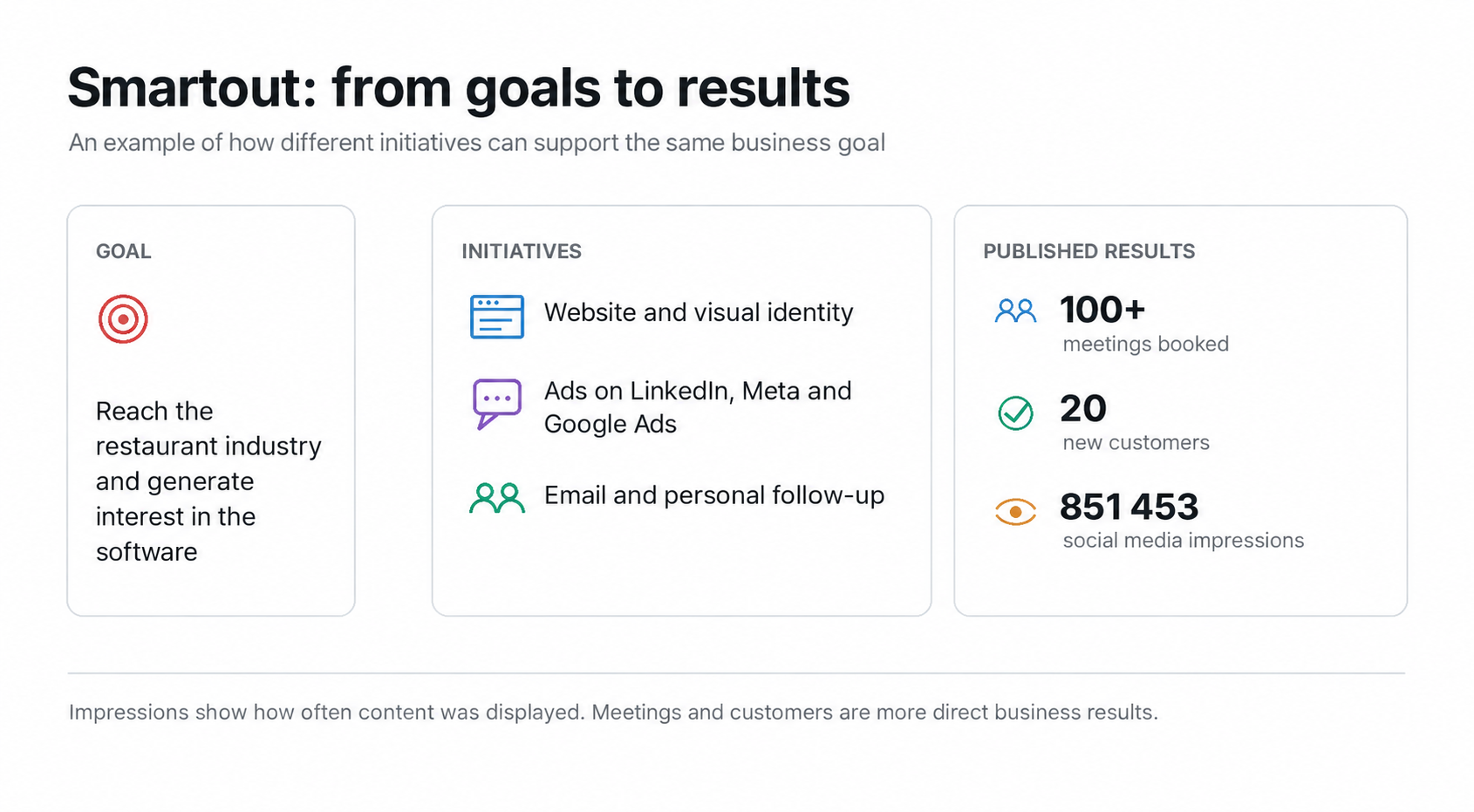
Here is how we helped Smartout present its software to the restaurant industry and connect with potential customers.
Smartout had developed a software solution for the restaurant sector. The challenge was not simply to make the product better known, but to reach the right market and generate interest among potential buyers.
The target audience was clear: businesses in the restaurant industry. To present the solution effectively, we developed a website, visual identity and logo. This helped potential customers understand the product before the first conversation.
The goal was not just to run ads, but to start conversations with potential buyers and book meetings. We therefore combined LinkedIn, Meta and Google Ads campaigns with automated emails, personalised LinkedIn outreach and phone calls. The website introduced the product, while direct outreach helped open conversations with potential customers.
In the published case study, we report more than 100 meetings booked and 20 new customers. The project also generated 851,453 social media impressions. Impressions tell us how often the content was displayed, while meetings and new customers are more directly connected to the business goal.
When developing your own strategy, ask a similar question: What do we want customers to do after seeing our offer, and what will help them take that next step? Read the full Smartout case study.
You do not need a lengthy document to get started. Try answering these seven questions:
Use these questions as a short working plan. Even a simple strategy becomes more valuable when you can explain why you made each choice.
A good marketing strategy is not about doing everything at once. It is about prioritising what matters most to your business. Start with your goals and customers, choose a few high-priority activities, allocate resources and agree on how you will measure success.
At We Assist, we see marketing as one connected process: we define the challenge, choose the right tools, help customers move through the buying journey and measure the results. That is how individual activities become a considered strategy.
Would you like help developing or implementing a marketing strategy? Learn more about strategy and digital marketing at We Assist.


