.webp)
.webp)


Is your SEO growing – or are more people just searching for your name?
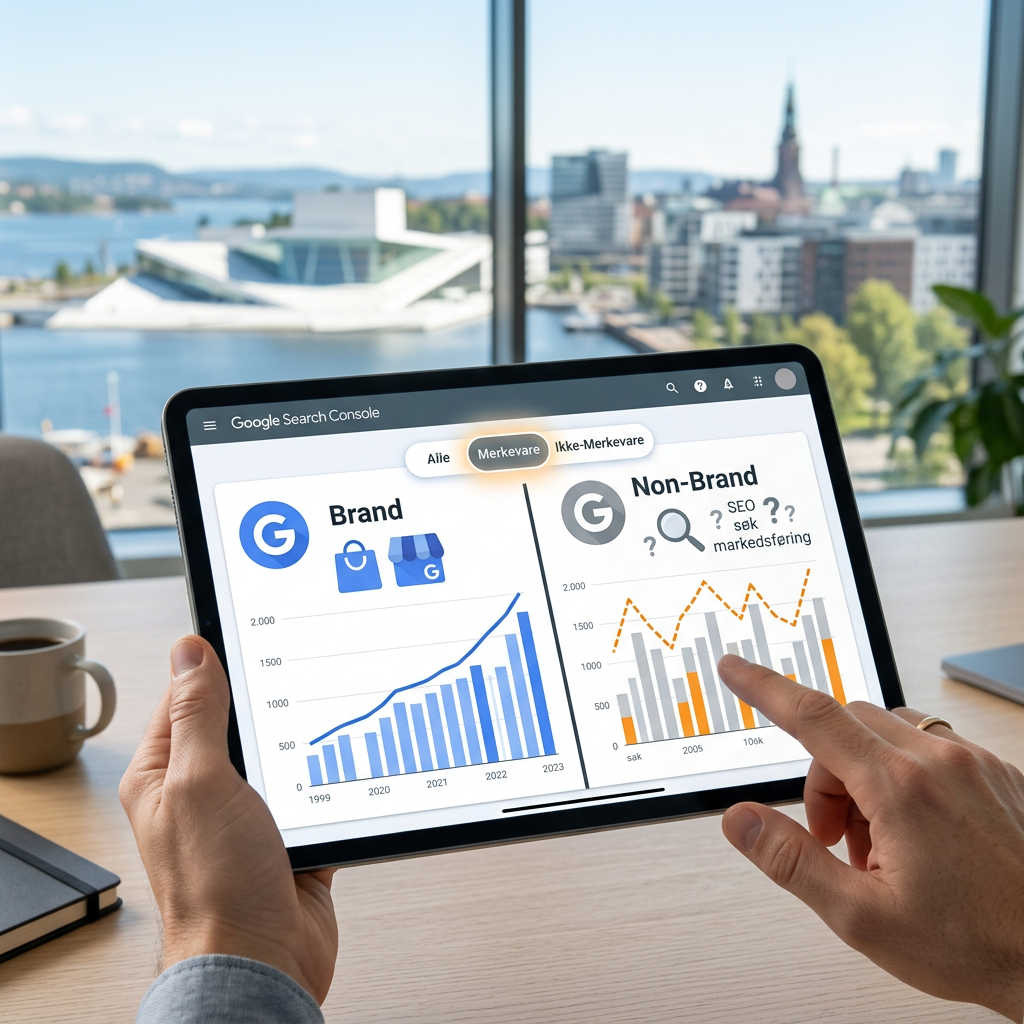
Is organic traffic increasing because your SEO is working better, or because more people already know your brand? Google's new brand filter in Search Console makes it easier to tell the difference.
Is organic traffic increasing because you are becoming more visible on Google, or because more people already know your brand? Google's new brand filter in Search Console makes it much easier to tell the difference.
It is easy to see an increase in organic traffic and conclude that your SEO strategy is working.
But imagine that your company has simultaneously increased advertising on Meta, been featured in the media, or run a major campaign. More people start searching directly for your company name. Your Google traffic increases, but that does not necessarily mean you have become more visible for searches like "accountant Oslo," "women's running shoes," or "Shopify agency."
This has long been a challenge when evaluating SEO results.
Google has now made it much easier.
Google launched the filter for branded queries in Search Console at the end of 2025. As of March 11, 2026, the feature was made available to all websites that meet Google's requirements, including data volume.
The filter divides searches into two main groups:
Branded: Searches that Google associates with your brand.
Non-branded: Searches that are not linked to your brand.
Google does not just use a simple list of words. The classification is performed using an AI-based system that can, among other things, understand:
A search therefore does not necessarily need to contain your exact company name to be classified as branded.
Let's say a Norwegian online store is called Fjellsko.
A person searching for:
"Fjellsko"
is likely already familiar with the brand.
A person searching for:
"best hiking boots for Norwegian mountains"
has a completely different intent. The person is looking for a solution, not necessarily for Fjellsko.
The same distinction applies to a Danish B2B company.
A search for:
"Company name accounting"
is something different than:
"accounting software for small businesses"
Both may result in a click from Google, but they tell two completely different stories about your visibility.
The new filter is not limited to US websites. Search Console can also be filtered by country, making it possible to analyze, for example, Norway and Denmark separately if you operate the same website across different markets.
This is especially important when reporting SEO results.
Consider the following scenario:
Organic clicks increase from 5,000 to 7,000 over six months.
On the surface, this looks like 40 percent growth.
But when you break down the traffic, we might see:
Suddenly, the story looks completely different.
The company has become better at creating demand for its brand—which is certainly positive—but visibility for generic searches has actually declined.
The opposite can also happen.
If non-branded impressions and clicks grow, it may be a sign that Google is showing the company for more relevant searches where users are not yet explicitly looking for the brand.
This is often exactly the type of growth that SEO efforts aim to create.
The point is not to get the branded share as low as possible.
Quite the opposite.
A growing brand should often see an increase in searches for its own name. This can be the result of advertising, recommendations, social media, PR, existing customers, or general brand building.
Branded traffic and non-branded traffic simply answer different questions.
Branded traffic, among other things, indicates the demand for the brand.
Non-branded traffic tells you more about how visible your site is to people searching for a topic, product, or problem without explicitly asking for your brand.
Google itself describes non-branded searches as useful for understanding organic growth and how new users discover your content.
Open Google Search Console → Performance → Search results.
Under the search data filters, eligible sites can choose between branded and non-branded queries.
You can then analyze:
For example, you can choose Non-branded + Country: Denmark to examine how the website is performing for general Danish searches.
Or compare the trend in non-branded impressions over the last six months with the previous period.
For most businesses, reporting doesn't need to be complicated.
Increasing impressions can mean that Google is showing your website for more relevant searches – even before the user clicks.
This can be an early sign of growing organic visibility.
This shows how much traffic the website actually receives from searches that are not classified as brand-related.
Look at the trend over time, not just a single month.
A significant change can reveal something important.
Has branded traffic suddenly grown after a major Meta campaign? That can be an interesting signal of increasing brand demand.
Has non-branded traffic grown after you expanded your category pages and expert content? If so, you should investigate which pages and searches are driving that growth.
However, be careful about drawing conclusions about causality based solely on Search Console. The data shows what happened in Google, not necessarily what caused it.
Google itself emphasizes that the classification is done using AI, and that some searches may end up in the wrong category.
There are also other limitations.
The filter is not available for sites with too few impressions, and it does not appear on certain sub-properties that only cover a folder or subdomain. Furthermore, Google hides some searches for privacy reasons.
The numbers should therefore be used as an analytical tool – not as a perfect source of truth.
The new filter does not solve all the challenges of SEO measurement, but it makes one important thing much easier:
It distinguishes better between people who are explicitly looking for the brand and people who find the company through other searches.
For Norwegian and Danish companies, this means that reporting can become more precise.
Instead of just saying:
"Organic traffic increased by 25%."
we can ask:
Where did the growth actually come from?
Did your brand become more in demand?
Did the company become more visible in general searches?
Or did both grow at the same time?
These are far more useful questions when determining what is actually working – and what the SEO strategy should prioritize moving forward.
WeAssist helps Norwegian and Danish companies with SEO, Search Console, and organic visibility analysis.
We can map out which searches and pages are driving growth, distinguish between branded and non-branded traffic, and identify untapped potential on Google.
Get in touch with WeAssist or read more here if you want a clearer SEO strategy based on what customers are actually searching for.
.webp)